

David Beamonte
28 May 2026
Most modern datacenters are inherently heterogeneous. VMware environments coexist with container platforms, databases, and other bare-metal workloads, often on the same hardware over several years. Servers are bought once, but their role changes as requirements evolve.
However, ESXi (the VMware hypervisor) provisioning is often handled separately. Hosts are installed using VMware tooling, custom scripts, or automations that are designed to deploy ESXi onto the machine. These workflows are effective in isolation, but they don’t always integrate with how the rest of the physical infrastructure is tracked and managed.
The result is a disconnect: ESXi hosts are handled differently from the rest of the datacenter, even though they are in the same pool of hardware. As environments grow and diversify, this separation becomes a limitation.
A more scalable approach is to treat ESXi as part of a shared bare-metal platform. This aligns ESXi provisioning with the way hardware is already reused, repurposed, and operated across a heterogeneous datacenter.
Managing ESXi: From installation to host management
Traditional ESXi workflows focus on individual hosts. In some environments this is done manually, whereas in others it relies on a mix of VMware-specific tooling, shell scripts, or configuration management systems.
Once the host is up, the automation typically stops. The expectation is that a machine will remain an ESXi host for most of its life. Rebuilds, hardware refreshes, and role changes are treated as exceptional events rather than routine operations.
This host-centric model does not scale well in environments where requirements change frequently. Hardware becomes obsolete, clusters change size, and platforms come and go. Treating ESXi hosts as static elements can make these transitions slow and error-prone.
Modern datacenters use a different approach. Physical servers are treated as a pool of resources that can be allocated, released, and redeployed. ESXi becomes one of several roles a machine can take, rather than a permanent label applied at first install. The goal is no longer to automate ESXi installation in isolation, but to manage ESXi as part of a broader bare-metal lifecycle that also serves other platforms and workloads.
MAAS: a hardware- and OS-agnostic control plane
MAAS provides a bare-metal control plane with a very clear and deterministic machine lifecycle: it discovers, inventories, and manages physical servers regardless of the vendor. It treats bare metal as an API-driven resource, rather than a collection of individually managed machines.
Key characteristics of MAAS include:
- Automated hardware lifecycle management: MAAS automatically discovers, inventories, commissions, and deploys physical servers. Through the server’s baseboard management controller (BMC), MAAS can manage remote power and other out-of-band controls.
- Infrastructure-as-code automation: MAAS manages the complete hardware lifecycle programmatically as code, using a cloud-like API. It also integrates with DevOps tools like Terraform, Juju and Ansible to automate, orchestrate, and model entire physical infrastructure deployments from a single workflow.
- Integrated hardware diagnostics: It enables the execution of pre-commissioning tests to establish a performance baseline and verify the integrity of critical components, ensuring only compliant and healthy machines are provisioned.
- Hardware-agnostic: MAAS manages servers from multiple vendors in a single inventory.
- Network configuration: MAAS models the network configuration which is applied consistently to the physical servers during deployment. This ensures ESXi hosts are provisioned with the correct connectivity without the need for VMware-specific tooling.
- OS-agnostic: You can deploy ESXi, Linux, or Windows using the same lifecycle model.
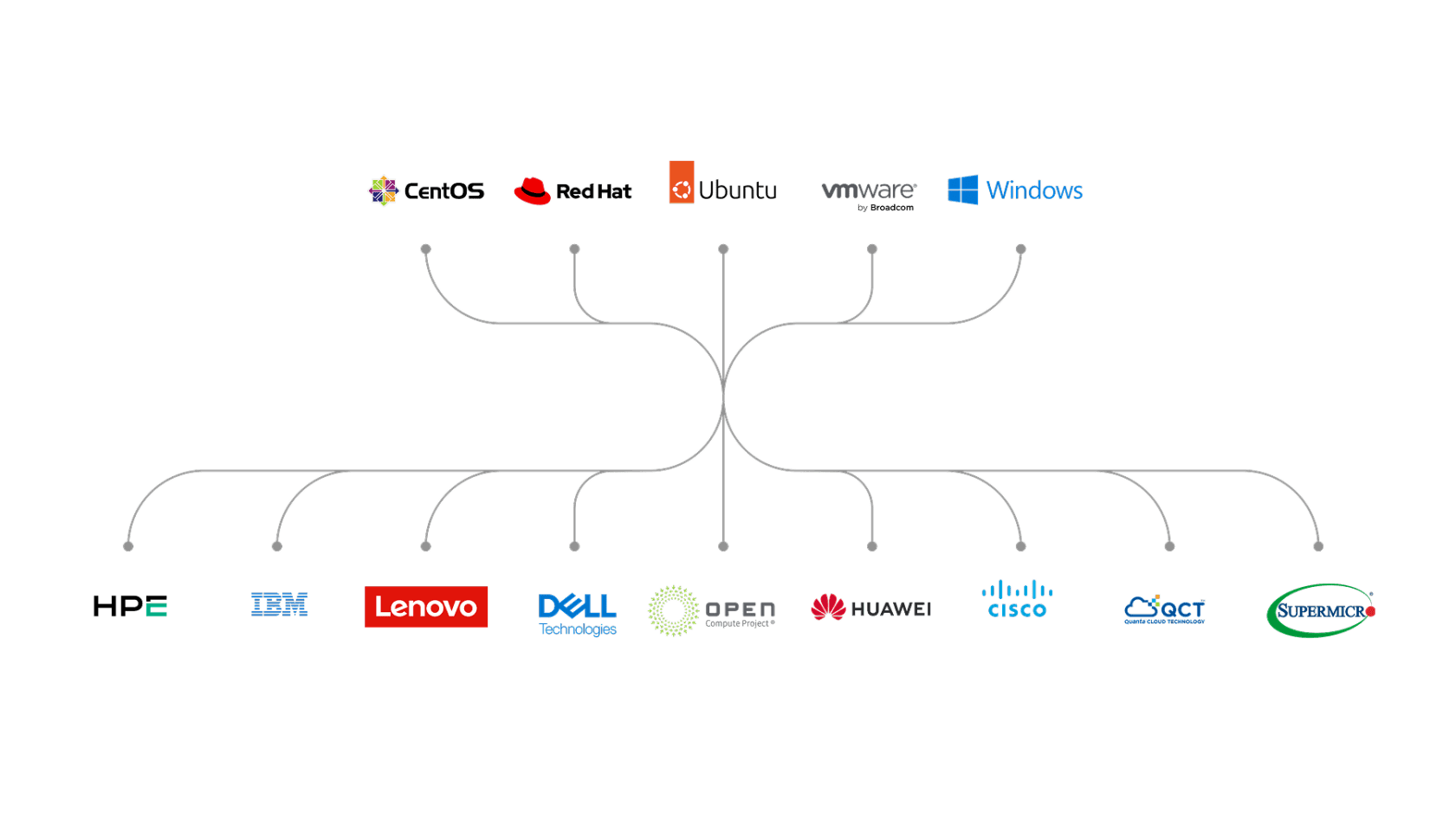
For MAAS, the deployment of VMware hypervisor is not a special case. ESXi becomes another supported operating system (OS) for the bare-metal platform.
How MAAS deploys ESXi
From MAAS’s perspective, ESXi deployment follows the same lifecycle as any other operating system. First, new servers are discovered, inventoried and commissioned. During commissioning, MAAS inspects CPUs, memory, storage devices, and network interfaces, and records that information in its database. At this stage, the machine is just hardware ready to be used, not an ESXi host.
Networking and storage are modelled in MAAS. Interfaces, bonds, VLANs, IP allocation, boot disks, and datastore disks are defined once at the bare-metal layer and reused across deployments.Before deploying ESXi images to the machines, they need to be created as a custom image and uploaded to MAAS. When ESXi is deployed, MAAS partitions the storage, writes the hypervisor image to the disk and applies post-deployment configurations. This can include tasks such as registering the host with vCenter.
One bare-metal platform for VMware and more
Many datacenters run more than one platform. VMware hosts sit next to container clusters, databases, and other bare-metal systems, often on the same hardware over its lifetime.
Using MAAS as a common control plane ensures that all the physical servers’ lifecycle is managed in the same way. The same machine can run ESXi today and be reused later for a different purpose without introducing a new provisioning path.
To learn more about how MAAS can help you with your VMware hypervisor deployment, check out the following resources:
- Learn more about MAAS and its role as a bare-metal control plane:
https://canonical.com/maas - Walk through a practical ESXi deployment using MAAS:
https://canonical.com/maas/tutorials/maas-esxi-quickstart - Consult Canonical’s broader documentation for related infrastructure topics:
https://canonical.com/docs
Or contact us if you want to learn how Canonical can support you.


